
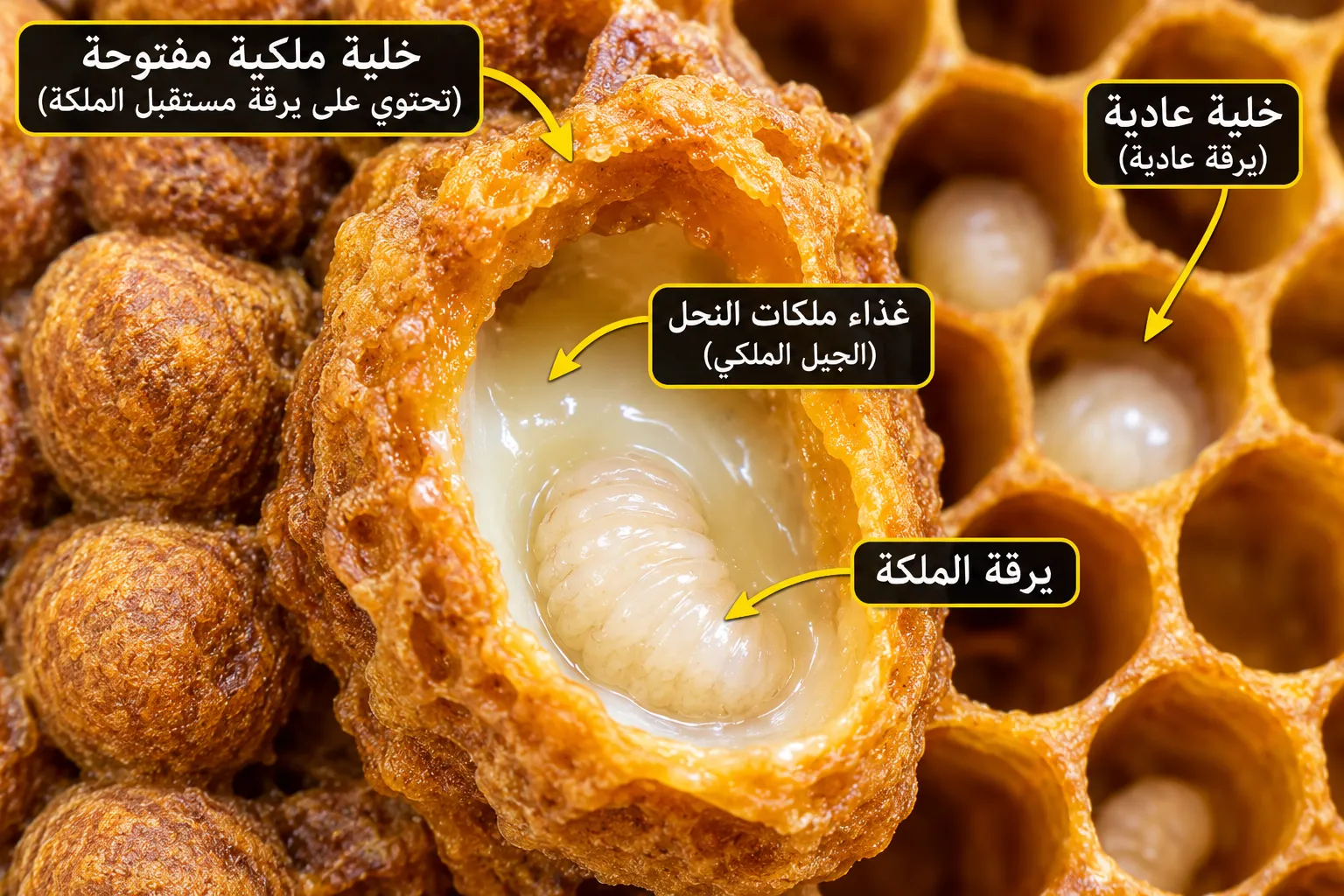
Royal Jelly: Production, Extraction, Storage, and the Science Behind the 10-HDA Quality Standard
A research-based guide to how bees make royal jelly, how beekeepers harvest and preserve it, what the 10-HDA percentage on a label actually means, and what clinical and laboratory research says about its effects on the body.
Key takeaways
Royal jelly is a glandular secretion — not a simple pollen product — made exclusively by young nurse honeybees (Apis mellifera) between roughly 5 and 15 days of age.
Commercial harvesting relies on the grafting technique: young larvae are transferred into artificial queen cups, and the jelly is collected 68–72 hours later, at peak volume.
Fresh royal jelly is highly perishable. Refrigeration, freezing, and freeze-drying (lyophilization) are the three main preservation routes, each with a different effect on shelf life and potency.
The compound 10-HDA (10-hydroxy-2-decenoic acid) — not to be confused with any vitamin D derivative — is the internationally recognized marker of royal jelly's freshness, purity, and quality.
ISO 12824:2016 sets a regulatory floor of 1.4 g of 10-HDA per 100 g of fresh royal jelly. Commercial products are then further graded above that floor — commonly at 1.3%, 1.8%, 2%, 3%, or higher in concentrated powders — and a 1.8% versus a 2% declaration reflects two different commercial quality/concentration tiers, not two different substances.
A growing body of randomized controlled trials and laboratory research links royal jelly to effects on menopausal symptoms, lipid and glucose metabolism, wound healing, immune and antimicrobial activity, and neuroprotection — though the strength of evidence varies by condition.
What exactly is royal jelly?
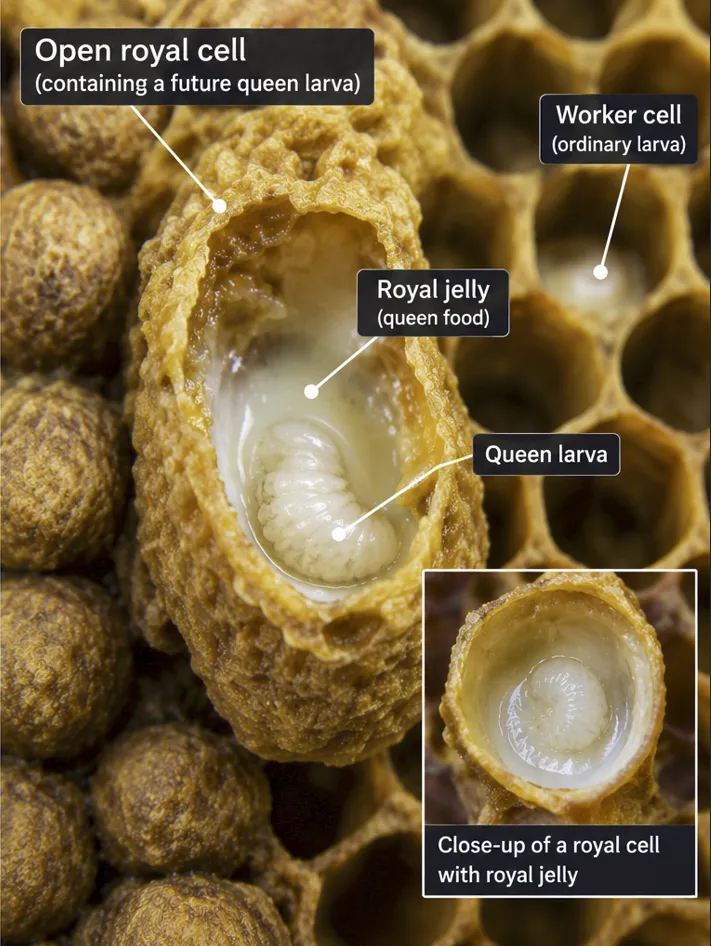
Royal jelly is a thick, milky-white to pale-yellow secretion produced by young worker honeybees to feed the queen bee throughout her life and all honeybee larvae during their first days of development. Chemically, it is roughly 60–70% water, 12–15% proteins, 10–12% carbohydrates (mainly fructose and glucose), 3–7% lipids, plus free amino acids, B-complex vitamins, and trace minerals such as potassium, iron, zinc, and copper.
Two components make royal jelly unique among bee products. The first is a family of glycoproteins called Major Royal Jelly Proteins (MRJPs 1–9), which make up roughly half of its dry weight; MRJP1 (also called royalactin) is the protein most closely tied to caste determination — it is a major reason a genetically identical larva becomes a queen rather than a worker. The second is 10-hydroxy-2-decenoic acid (10-HDA), a medium-chain unsaturated fatty acid found almost nowhere else in nature, which accounts for a large share of the lipid fraction and is used worldwide as the chemical fingerprint of genuine royal jelly.
How bees produce royal jelly
Royal jelly is synthesized and secreted by two paired exocrine glands inside the heads of young worker bees: the hypopharyngeal glands and, to a lesser extent, the mandibular glands. These glands are not active throughout a worker bee's life — their development follows a strict age-based division of labor known as age polyethism.
Newly emerged workers have small, undeveloped glands.
Around day 5–7 of adult life, the glands enlarge rapidly as the bee moves into the "nurse bee" role.
Peak secretory activity occurs around day 6–12, when the acinar cells of the hypopharyngeal glands are at their largest and most active.
Once a nurse bee transitions to foraging (collecting nectar and pollen outside the hive), the glands regress and stop producing jelly, switching instead to producing invertase, an enzyme used to convert nectar into honey.
The raw material for this secretion comes largely from pollen. Protein-rich pollen consumption drives the production of vitellogenin, a yolk-protein precursor circulating in the bee's hemolymph (blood), which nurse bees convert into the protein-dense royal jelly inside their glands. This is why colonies with restricted pollen access produce measurably less, and lower-quality, royal jelly — a fact beekeepers use when deciding whether a colony is strong enough to put into royal jelly production. Nurse bees then secrete the jelly directly into the mouths of larvae and into queen cells, with the queen and the youngest larvae receiving it in far greater volume than worker or drone larvae, which are switched to a pollen/honey mixture after about day 3.
At the molecular level, research using proteomic and transcriptomic analysis has shown that "high royal jelly producing" bee lines have markedly more active protein- and energy-metabolism pathways in their hypopharyngeal glands than ordinary lines, and that the genes for MRJP1, MRJP4, and MRJP5 are dramatically upregulated in nurse bees compared with foragers of the same age — confirming that royal jelly output is both an age-dependent and a genetically heritable trait that commercial beekeepers can select for over generations.
How humans harvest royal jelly
Because only queen larvae receive copious, uninterrupted royal jelly, commercial harvesting is inseparable from queen-rearing technique. The standard method used worldwide is larval grafting:
Colony preparation. A strong, queenless or queen-excluded "starter" colony with abundant young nurse bees and ample pollen stores is prepared, since colony strength and nutrition directly determine both the acceptance rate of grafted larvae and the final yield.
Grafting. Using a fine grafting tool or needle, the beekeeper transfers worker larvae roughly 12–24 hours old from a brood comb into artificial plastic queen cell cups mounted on a frame. Larval age and the technician's precision both affect how many larvae the nurse bees accept and feed.
Feeding period. The frame of grafted cups is returned to the colony. Nurse bees, "tricked" into treating the larvae as queen candidates, flood the cups with royal jelly continuously.
Harvest timing. Royal jelly is collected 68–72 hours after grafting. Research comparing harvest intervals of 24, 48, 72, and 96 hours consistently finds that total yield per cell peaks at 72 hours — typically 150–350 mg of jelly per queen cup, compared with as little as 70 mg at 24 hours — which is why 72 hours is the industry-standard window, even though some mineral concentrations are actually highest at 48 hours.
Extraction. The wax cap of each cell is sliced away, the larva is removed and discarded (it would otherwise contaminate the jelly), and the jelly is drawn out of each cup with a small spoon, spatula, or suction device. It is then filtered through a fine mesh to remove wax fragments and larval debris.
Immediate cold-chain handling. Because royal jelly degrades quickly at room temperature, hygiene protocols (reflected in the ISO 12824:2016 production standard) require that harvested jelly be placed into food-grade containers and refrigerated or frozen without delay.
Cycle repetition. A production frame can be re-grafted and harvested again every 3 days, so an established, well-fed colony can be harvested repeatedly across a 5–6 month season, with a single strong hive capable of yielding roughly 500 g of royal jelly over that period.
A newer, non-grafting method has also been developed and patented in China, in which colonies are managed so that queens lay directly into cell cups, removing the need for manual larval transfer — but grafting remains the dominant commercial technique globally because of its reliability and scalability.
How royal jelly is stored and preserved
Fresh royal jelly is chemically unstable. Exposure to oxygen, light, and heat accelerates browning and nutrient loss through the Maillard reaction (the same chemical process that browns baked bread), progressively degrading its proteins, sugars, and 10-HDA content. Three preservation routes are used commercially, each with a different stability profile:
Refrigeration (around 4 °C). This is the standard short-to-medium-term storage method for fresh royal jelly intended for near-term sale or use. Under good cold-chain conditions, refrigerated fresh royal jelly can remain within specification for up to roughly 18 months, though many retail products specify shorter windows once opened.
Deep freezing (−17 °C to −20 °C). Freezing essentially halts the enzymatic and chemical degradation that occurs at warmer temperatures, extending usable shelf life to roughly 24 months. This is the preferred method for bulk transport and storage of fresh royal jelly between the apiary and the processing facility.
Lyophilization (freeze-drying). For longer shelf life and easier standardization into capsules or powders, fresh royal jelly is freeze-dried under vacuum at very low temperatures (commonly between −40 °C and −70 °C) for several hours, reducing its moisture content from roughly 65% down to about 5%. This process both concentrates the jelly (roughly 3 parts fresh jelly become 1 part powder) and dramatically improves its stability at room temperature, commonly cited at around 6 months unrefrigerated and up to 2 years under refrigeration. The trade-off is that, because the active compounds are now concentrated rather than removed, any heat damage sustained during drying or long-term storage at room temperature is also concentrated; well-controlled studies have found that 10-HDA levels in good-quality lyophilized royal jelly held steady above the declared label value throughout the stated shelf life, provided the product was protected from light and excessive heat.
Practical storage guidance that follows directly from this research: keep royal jelly, fresh or lyophilized, in an opaque, airtight container; store it in the refrigerator or freezer rather than at room temperature whenever possible; minimize repeated freeze–thaw cycles; and treat any pronounced darkening or change in smell as a sign of degradation rather than normal variation.
The 10-HDA marker: what it is, and what different percentages mean
What 10-HDA actually is
The compound at the center of royal jelly quality control is 10-hydroxy-2-decenoic acid, universally abbreviated 10-HDA and sometimes nicknamed the "queen bee acid." It is an unsaturated, medium-chain fatty acid with a hydroxyl group on its tenth carbon — chemically unrelated to vitamin D or any of its derivatives, despite that association sometimes appearing in non-technical sources. 10-HDA typically makes up 50–70% of the total lipid fraction of royal jelly and is not found in any other natural bee product, which is exactly why regulators and laboratories use it as the definitive marker for both the authenticity (is this really royal jelly?) and the freshness/quality (how well was it produced and preserved?) of a given batch.
The regulatory floor: ISO 12824:2016
The international reference standard, ISO 12824:2016 ("Royal jelly — Specifications"), adopted in France as NF ISO 12824, sets both production/sanitary requirements and a chemical specification for royal jelly sold as a genuine product. Its key chemical requirement is a minimum 10-HDA content of 1.4 g per 100 g of fresh royal jelly (1.4%). Independent laboratory surveys using HPLC analysis have found that genuinely fresh, well-produced royal jelly samples typically range from about 1.5% up to 3.8% 10-HDA, while market surveys of commercial products sold without proper quality control have sometimes found a meaningful share of samples falling below the 1.4% regulatory floor — underscoring why an independently verified 10-HDA assay matters when evaluating a supplier.
Why percentages vary: 1.8% versus 2%, and higher
Above that 1.4% regulatory minimum, manufacturers commonly standardize and declare their royal jelly at specific guaranteed concentrations — figures such as 1.3%, 1.8%, 2%, 3%, and, in concentrated freeze-dried powders, up to 4.8–6% are all seen on the market. A product labeled at 2% 10-HDA and one labeled at 1.8% 10-HDA are not two different substances; they are two different quality/concentration tiers of the same compound, with the 2% product delivering roughly 11% more of this marker fatty acid per gram than the 1.8% product, all else being equal. Several factors explain why one batch ends up higher than another:
Harvest timing. 10-HDA concentration (as a percentage of the jelly) tends to decline the longer jelly sits in the cell past about 48 hours, even though total harvestable mass keeps rising through 72 hours — so the exact harvest window chosen by the producer has a direct, measurable effect on the final percentage.
Bee genetics and forage. Different honeybee lines and different pollen/nectar sources available to the colony measurably change 10-HDA output, which is part of why royal jelly from different regions and seasons is not chemically identical.
Freshness and storage history. Because 10-HDA degrades progressively with heat, light, and time, a higher declared percentage on a well-tested product is also, in practice, often a reasonable proxy for a fresher, better-handled batch — though this is not automatic, since concentration through lyophilization can also raise the percentage independent of freshness.
Deliberate standardization. Reputable producers blend or select batches to guarantee a consistent, stated percentage on every lot, which is why serious brands publish an HPLC certificate of analysis rather than relying on an average or an estimate.
Because the percentage is also the main lever for marketing claims, buyers should be aware that it is technically possible — and has been documented as a fraud concern in some supply chains — to artificially raise the measured 10-HDA value by spiking a batch with isolated 10-HDA rather than relying on the compound naturally present in genuine, well-handled jelly. This is precisely why independent HPLC testing and recognized quality labels exist: the percentage on its own is a useful quality signal, but it is most reliable when it comes with a verifiable lab certificate rather than a bare label claim.
The scientific evidence: what research says about royal jelly and disease
The sections below summarize controlled research by physiological system, distinguishing clinical (human) trials from preclinical (animal and cell-based) research, since the strength of evidence differs considerably between the two.
Menopausal symptoms and hormonal balance
Multiple randomized, placebo-controlled human trials have tested oral royal jelly in menopausal women. A 2018 double-blind trial published in Evidence-Based Complementary and Alternative Medicine gave healthy postmenopausal Japanese women 800 mg of enzyme-treated royal jelly daily and found measurable improvements in backache, low-back pain, and anxiety compared with placebo over several weeks. A separate Iranian double-blind randomized trial involving roughly 200 women, using 1,000 mg of royal jelly daily for eight weeks, reported that menopausal symptom scores on the validated Menopause Rating Scale nearly halved compared with a much smaller change in the placebo group, with no side effects reported during the trial. A further randomized trial testing vaginal royal jelly against conjugated estrogen reported improved quality-of-life and vaginal atrophy scores in postmenopausal women. Evidence is not uniformly positive, however: a dedicated sub-study of a similarly designed trial found that a 1 g daily oral dose for eight weeks did not significantly improve genitourinary syndrome of menopause specifically, even though it caused no adverse effects — a reminder that royal jelly's benefit appears to depend on the specific symptom cluster, dose, and route of administration.
Cardiometabolic health: lipid profile and blood glucose
A randomized pilot trial in women with type 2 diabetes, published by researchers at Tabriz University of Medical Sciences, gave 1,000 mg of royal jelly daily for eight weeks and found statistically significant reductions in triglycerides, total cholesterol, and high-sensitivity C-reactive protein (a marker of inflammation) relative to placebo. Animal research reinforces a plausible mechanism: in streptozotocin-induced diabetic rats, royal jelly supplementation significantly lowered glucose, total cholesterol, triglycerides, and LDL cholesterol while raising protective HDL cholesterol, and a honey–royal jelly mixture normalized glycemic control markers, including HbA1c, in a separate rodent model. These effects are not universal or instantaneous, though: a controlled human trial testing a single 10 g dose of fresh royal jelly in people with type 2 diabetes found no significant short-term change in glycemic response, suggesting that any metabolic benefit likely requires sustained daily supplementation rather than a one-off dose.
Immune function and antimicrobial activity
Royal jelly contains its own antimicrobial peptides — defensin-1 (royalisin) and a family of smaller peptides called jelleins — alongside 10-HDA, which laboratory studies show has direct antibacterial action, including a demonstrated ability to reduce biofilm viability of Staphylococcus aureus, a common and often treatment-resistant pathogen. Reviews of the antimicrobial literature consistently report that whole, intact royal jelly shows stronger antibacterial activity than isolated fractions tested individually, suggesting these components act synergistically. This combination of antimicrobial peptides and fatty acids is also the biological mechanism nurse bees themselves rely on to protect the hive's most valuable larvae from infection.
Wound healing and skin regeneration
Cell-culture research using human skin cells (keratinocytes and dermal fibroblasts) has identified several of royal jelly's major proteins (MRJP2, MRJP3, and MRJP7) as drivers of the proliferation and migration needed for wounds to close, while 10-HDA and defensin-1 appear to support healing further by reducing local inflammation and stimulating growth-factor synthesis. In animal models, topical royal jelly has been shown to shorten healing time in both infected and uninfected wounds, including models of diabetic foot ulcers, which are notoriously slow to heal through conventional means. Separately, royal jelly standardized to a measured 10-HDA content has been shown in fibroblast studies to increase production of procollagen type I and transforming growth factor-beta 1 (both central to tissue repair and firmness) without increasing the collagen-degrading enzyme MMP-1, and to reduce expression of tyrosinase, the enzyme responsible for pigment (melanin) production — findings that underpin royal jelly's use in anti-aging and skin-brightening cosmetic formulations.
Neuroprotective and cognitive effects
The most striking neurological findings come from animal models of cognitive decline. In a rat model of sporadic Alzheimer's disease induced by intracerebroventricular streptozotocin injection, two weeks of oral royal jelly produced measurable improvements in working memory alongside reduced neurodegeneration, reduced oxidative stress, and increased neurogenesis in the hippocampus — the brain region most associated with memory formation. In a separate model using trimethyltin-intoxicated mice, orally administered royal jelly significantly increased the number of newly generated granule cells in the hippocampal dentate gyrus and, in parallel, improved cognitive test performance. Mechanistically, royal jelly's major protein MRJP1 (royalactin) has been shown to influence brain cell signaling, and royal jelly as a whole appears to encourage the differentiation of neural stem and progenitor cells. These findings are preclinical (animal-based) rather than drawn from large human cognitive trials, so they should be read as promising biological evidence of a neuroprotective mechanism rather than as proof of a treatment for Alzheimer's disease or dementia in people.
The underlying thread: antioxidant and anti-inflammatory activity
Across nearly every system discussed above, researchers point to the same two underlying mechanisms: royal jelly's flavonoids, phenolic compounds, and 10-HDA scavenge free radicals (measurable in standard DPPH antioxidant assays), and several of its components measurably reduce the production of pro-inflammatory signaling molecules in cell and animal studies. This dual antioxidant/anti-inflammatory action is the common biological thread that researchers use to explain royal jelly's wide-ranging effects on metabolic, dermatological, immune, and neurological outcomes alike.
Frequently asked questions
What is royal jelly made of?
Royal jelly is roughly 60–70% water, 12–15% protein, 10–12% carbohydrate, and 3–7% lipid, with the lipid fraction dominated by the unique fatty acid 10-HDA, alongside B vitamins, free amino acids, and trace minerals.
How long does it take bees to produce royal jelly?
Nurse bees develop the glandular capacity to secrete royal jelly around day 5–7 of adult life, with peak production between roughly day 6 and day 12; commercially, beekeepers harvest the jelly accumulated in grafted queen cells 68–72 hours after grafting.
What is 10-HDA, and why does it matter?
10-HDA (10-hydroxy-2-decenoic acid) is a unique fatty acid found almost exclusively in royal jelly. It is the internationally recognized chemical marker used to confirm that a product is genuine royal jelly and to assess its freshness and quality, and it also carries antimicrobial, antioxidant, and anti-inflammatory activity in its own right.
What is the difference between 1.8% and 2% 10-HDA royal jelly?
Both are commercial quality grades above the international regulatory minimum of 1.4%. A 2%-labeled product contains a somewhat higher concentration of the marker compound than a 1.8%-labeled one — about 11% more per gram — reflecting differences in harvest timing, bee genetics, freshness, or the degree of concentration applied during processing, rather than two different ingredients.
What is the minimum 10-HDA percentage for royal jelly to be considered genuine?
Under ISO 12824:2016, fresh royal jelly must contain at least 1.4 g of 10-HDA per 100 g (1.4%) to meet the international specification for royal jelly.
Is fresh or freeze-dried (lyophilized) royal jelly better?
Fresh royal jelly offers maximum bioavailability but is highly perishable and must be kept refrigerated or frozen. Lyophilized (freeze-dried) royal jelly is more concentrated, far more stable at room temperature, and easier to standardize into capsules, making it the more practical choice for long-term storage and travel, provided it is sourced from a reputable, lab-tested supplier.
How should royal jelly be stored at home?
Keep it in an opaque, airtight container in the refrigerator (around 4 °C) for short-to-medium-term use, or in the freezer for longer storage; avoid repeated freeze–thaw cycles and keep it away from direct light and heat, which accelerate degradation of its proteins and 10-HDA content.
Can royal jelly help with menopause symptoms?
Several randomized, placebo-controlled human trials report improvements in menopausal symptoms such as hot flashes, backache, low back pain, and anxiety with daily royal jelly supplementation (commonly 800 mg–1,000 mg per day), though results vary by symptom and not every outcome measured in every trial has shown benefit.
Does royal jelly affect cholesterol or blood sugar?
A randomized pilot trial in women with type 2 diabetes found that eight weeks of royal jelly supplementation significantly reduced triglycerides, total cholesterol, and an inflammation marker (hs-CRP), and animal studies show similar improvements in glucose and lipid markers, though a single acute dose did not change short-term blood sugar readings in a human trial.
Is royal jelly's reputation based on tradition or on real science?
Both: royal jelly has centuries of traditional use, and in recent decades that use has been increasingly tested in randomized controlled human trials and mechanistic laboratory research covering menopausal symptoms, lipid and glucose metabolism, wound healing, antimicrobial activity, and neuroprotection — though, as with most natural products, the depth of clinical evidence varies by condition, and some findings remain limited to animal or cell-based studies rather than large human trials.