
Bee venom: composition, anatomy and scientific research
Reading time: about 14 minutes
In brief
Bee venom, also called apitoxin, is a colourless, acidic and bitter liquid produced by worker bees and the queen of the honeybee (Apis mellifera) for defence. It is made by the venom gland of the stinging apparatus, stored in a reservoir, and injected through the stinger. Its main component is melittin (40 to 50% of the dry matter), along with phospholipase A2, apamin, hyaluronidase and many other peptides, amines and volatile compounds. Research focuses on its anti-inflammatory, analgesic, antimicrobial and antitumour properties. Most findings come from in vitro and animal studies; clinical trials in humans remain limited and heterogeneous, and only venom immunotherapy for people with allergies is a firmly established medical use.
Table of contents
What is bee venom?
Where is the venom? Anatomy of the stinging apparatus
Physiology: production, storage and injection
Chemical composition of bee venom
The main components and how they act
Scientific research: what the studies show
How is venom harvested?
Conclusion
Frequently asked questions (FAQ)
References
1. What is bee venom?
Bee venom is a complex mixture of proteins, peptides, enzymes, biogenic amines, lipids and volatile compounds. Its common scientific name is apitoxin (from Latin apis, "bee", and Greek toxikon, "poison").
Its physical characteristics:
Appearance: clear, colourless liquid;
Smell: aromatic, reminiscent of honey and banana (due to volatile compounds);
Taste: bitter;
pH: acidic, about 4.5 to 5.5;
Water content (fresh venom): about 88%; once dried, it forms whitish-yellow crystals.
In the honeybee, venom serves above all to defend the colony against predators and robbers (vertebrates, wasps, other bees).
2. Where is the venom? Anatomy of the stinging apparatus
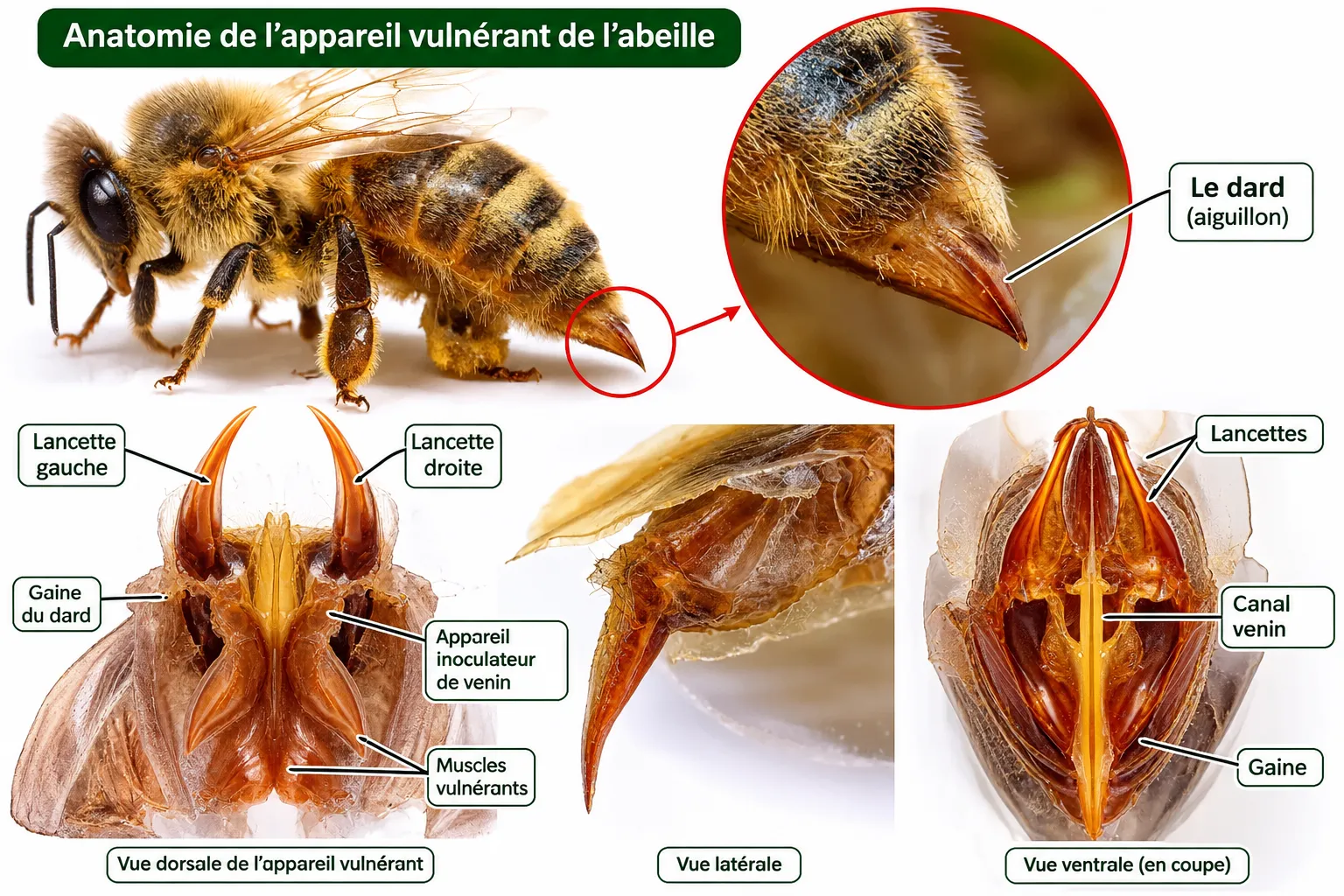
The bee's sting is a transformed ovipositor: it derives from the egg-laying organ of insects. This is why only females (workers and the queen) have a functional sting; drones (males) lack one.
The stinging apparatus is located at the tip of the abdomen and includes:
2.1 The producing glands
The acid gland (the venom gland proper): a long, tubular gland, often forked, whose secretory cells produce most of the venom components (melittin, phospholipase, etc.).
The alkaline gland: it secretes a fluid that mixes with the venom at the moment of injection and helps lubricate the system.
2.2 The reservoir (venom sac)
The product of the acid gland is collected in a muscular-membranous venom sac, where it is stored until use. It empties into the sting chamber through a short canal.
2.3 The sting and its mechanical parts
The sting is made of three main pieces:
the stylet, a dorsal piece that forms with the lancets a narrow canal;
two sliding lancets, equipped with barbs (small hooks pointing backwards) in the worker;
the sheath that encloses them.
The sting is operated by a set of chitinous plates (triangular, quadrangular and square) and muscles that alternately slide the lancets, progressively driving the sting in and propelling the venom.
Difference between worker and queen: the worker's sting is straight and barbed; the queen's is longer, curved and almost smooth. The queen uses it mainly against rival queens, rarely against other animals.
Interesting anatomical detail: when a worker stings a mammal's skin, the barbs hold the sting and the whole apparatus (sting, venom sac, muscles and a small nerve ganglion) tears away from the abdomen. This ganglion allows the muscles to keep pumping venom on their own for a short time after separation.
3. Physiology: production, storage and injection
Venom synthesis
Venom production begins in the first days of the worker's adult life. The cells of the acid gland synthesise peptides and enzymes, which accumulate in the reservoir. The amount stored increases with age and peaks around two weeks after emergence, when the bee moves from indoor tasks to guarding and then foraging. This timing matches its defensive role: the older bees, who are most exposed, are the best armed.
Quantities
A worker injects on average about 0.1 mg of venom (dry matter) per sting. The stored amount and composition vary with age, season, bee breed and colony nutrition. The queen produces a venom whose proportions of components differ from the worker's.
The alarm pheromone
When stinging, the bee also releases an alarm pheromone, whose main component is isopentyl acetate (banana odour). It is emitted by the Koschevnikov gland, located near the base of the sting, and not by the venom gland. It attracts and excites nestmates, who come to defend the colony.
The basic mechanism of action
Venom acts largely through a synergistic action: hyaluronidase weakens tissues and facilitates diffusion, phospholipase A2 attacks cell membranes, and melittin disrupts the integrity of these membranes. This combination explains the venom's defensive effectiveness and, in parallel, researchers' interest in its biological effects at very low concentrations.
4. Chemical composition of bee venom
The following table gives approximate proportions (as % of dry matter). They vary between studies, harvesting methods and bee origin.
Component | Nature | Approximate proportion |
|---|---|---|
Melittin | Peptide (26 amino acids) | 40 to 50% |
Phospholipase A2 | Enzyme | 10 to 12% |
Hyaluronidase | Enzyme | 1 to 3% |
Apamin | Peptide (18 amino acids) | 2 to 3% |
MCD peptide (401) | Peptide (22 amino acids) | 2 to 3% |
Adolapin, secapin, tertiapin, procamin, cardiopep | Minor peptides | about 1% each or less |
Histamine | Biogenic amine | 0.5 to 2% |
Dopamine, noradrenaline | Biogenic amines | < 1% |
Volatile compounds | Including isopentyl acetate | 4 to 8% |
Phospholipids | Lipids | about 5% |
Sugars | Glucose, fructose | about 2% |
Free amino acids | Including gamma-aminobutyric acid (GABA) | about 1% |
5. The main components and how they act
Melittin, the dominant component
Melittin is a small amphipathic peptide (with a hydrophilic and a hydrophobic part), with a molecular mass of about 2.8 kDa. It inserts into cell membranes and forms pores, which explains its strong lytic activity. At low doses it also modulates inflammatory signalling pathways, notably that of the nuclear factor NF-κB. It is the most studied molecule in the venom.
Phospholipase A2 (PLA2)
An enzyme of about 16 kDa, it hydrolyses membrane phospholipids and releases arachidonic acid, a precursor of inflammatory mediators. In some animal models, bee venom PLA2 has also been associated with stimulating regulatory T lymphocytes, which explains the interest it attracts in immunomodulation.
Apamin, a targeted neurotoxin
Apamin is an 18-amino-acid peptide that blocks SK potassium channels (small-conductance, calcium-activated). In some models it crosses the blood-brain barrier and is used in research as a pharmacological tool to study neuronal excitability.
Hyaluronidase, the "spreading factor"
This enzyme breaks down hyaluronic acid in connective tissue. It opens the way for the other components and speeds their diffusion through tissues.
MCD peptide and adolapin
The MCD peptide (mast cell degranulating peptide) triggers histamine release from mast cells at high doses, but has also shown anti-inflammatory properties at low doses. Adolapin is described as a cyclooxygenase inhibitor, giving it analgesic and anti-inflammatory activity in experimental models.
Biogenic amines
Histamine, dopamine and noradrenaline are present in small amounts and contribute to the initial local reaction.
6. Scientific research: what the studies show
The use of bee venom in traditional medicine (bee venom acupuncture, apitherapy) goes back several centuries, notably in Asia and the Middle East. For about twenty years, research teams, particularly in South Korea, China, the United States and Australia, have studied its components with modern methods.
How to read these results? It is essential to distinguish three levels of evidence: in vitro studies (on cells in the laboratory), animal studies, and human clinical trials. An effect seen at one level does not guarantee it will be confirmed at the next.
6.1 Inflammation, pain and joint diseases
This is the best-documented area. Review articles (Son et al., 2007; Wehbe et al., 2019; Zhang et al., 2018) describe that melittin and other components:
inhibit the NF-κB pathway and reduce the production of pro-inflammatory cytokines (TNF-α, IL-1β, IL-6) in cells and animal models;
produce an analgesic effect in rodents, involving mechanisms at the spinal cord level;
reduce signs of arthritis in several animal models.
In humans, clinical trials of bee venom acupuncture (injection of purified venom at acupuncture points) have been conducted in rheumatoid arthritis, knee osteoarthritis and chronic pain. A systematic review of randomised trials in rheumatoid arthritis (Lee et al., BMJ Open, 2014) concludes that the methodological quality of the trials is limited and that the evidence is insufficient to establish efficacy. Better-designed and larger trials are needed.
6.2 Neurological diseases
Parkinson's disease: in mouse models, bee venom and certain components (apamin, PLA2) showed a neuroprotective effect on dopaminergic neurons, with modulation of neuroinflammation. In humans, only small pilot trials exist, with preliminary results requiring confirmation.
Alzheimer's disease and amyotrophic lateral sclerosis: Korean teams have reported, in mouse models, a reduction in neuroinflammatory markers. These are preclinical studies with no clinical validation to date.
Multiple sclerosis: a randomised crossover trial in the Netherlands (Wesselius et al., Neurology, 2005), involving about twenty patients, showed no significant benefit on lesions, disability or relapse rate. This example illustrates the importance of not extrapolating from animal models.
6.3 Oncology research
Melittin is cytotoxic in vitro against many cancer cell lines. Two directions stand out:
Venom and melittin on breast cancer cells: an Australian study (Duffy et al., npj Precision Oncology, 2020) showed that bee venom and melittin rapidly destroyed aggressive breast cancer cells (triple-negative and HER2-positive) in the laboratory and reduced growth factor receptor signalling.
Nanoparticles: to bypass toxicity to healthy cells, American teams (Soman et al., J Clin Invest, 2009) designed nanoparticles carrying melittin that released it specifically into tumour cells in mice, reducing tumour growth.
These works are preclinical. No bee venom-based anticancer treatment is approved.
6.4 Antimicrobial and antiviral activity
Melittin is active in vitro against several bacteria, including some resistant strains such as methicillin-resistant Staphylococcus aureus (MRSA). Researchers at Washington University in St. Louis (Hood et al., Antiviral Therapy, 2013) also showed that melittin nanoparticles reduced HIV infectivity in the laboratory. Again, the results are experimental.
6.5 Dermatology
Korean trials evaluated cosmetics containing purified bee venom on acne (Han et al., Journal of Integrative Medicine, 2013), with reported improvements, in a context of small studies. Other work explores effects on skin inflammation and ageing.
6.6 The only established medical use: venom immunotherapy
Venom-specific immunotherapy (VIT) is a recognised treatment for people allergic to Hymenoptera stings: small, increasing doses of purified venom are given under medical supervision to induce tolerance. It is recommended by scientific societies (EAACI, Sturm et al., 2018) and is to date the best-validated application of bee venom in medicine.
Summary of evidence levels
Area | Level of evidence | Comment |
|---|---|---|
Allergy immunotherapy | Established (clinical) | Recommended by scientific societies |
Arthritis, osteoarthritis, pain | Limited clinical | Trials of variable quality, evidence judged insufficient |
Parkinson's, Alzheimer's, ALS | Animal, pilot human | Preliminary results |
Multiple sclerosis | Negative clinical | No benefit in a randomised trial |
Cancer | In vitro and animal | Leads based on nanoparticles |
Antibacterial, antiviral | In vitro | Experimental stage |
Acne (cosmetic) | Small trials | To be confirmed |
7. How is venom harvested?
Beekeepers collect venom with an electric collector: a plate fitted with fine wires is placed at the hive entrance, under a glass sheet. A weak current stimulates the bees, which sting the glass surface without being able to leave their sting behind. The venom deposits and dries into crystals, which are then scraped off. This method allows harvesting without sacrificing the bees and provides a standardisable venom for research and pharmacy.
8. Conclusion
Bee venom is a sophisticated biochemical cocktail, produced by a precise anatomical structure (acid gland, reservoir, sting) and optimised by evolution for colony defence. Its composition, dominated by melittin, phospholipase A2 and apamin, explains both its defensive efficacy and the interest of biomedical research. Ongoing work on inflammation, neuroprotection, oncology and infections is promising, but most of it still needs to be validated by rigorous clinical trials.
This article is provided for informational purposes and does not replace the advice of a health professional.
9. Frequently asked questions (FAQ)
What is bee venom?
Bee venom, or apitoxin, is an acidic, colourless liquid secreted by worker bees and the queen for defence. It is a mixture of peptides, enzymes, amines and volatile compounds.
What is the main component of bee venom?
Melittin, a 26-amino-acid peptide, makes up 40 to 50% of the venom's dry matter.
Where is venom produced and stored in the bee?
It is produced by the acid gland located in the abdomen, stored in the venom sac, and then injected through the sting thanks to a system of plates and muscles.
How much venom does a bee inject?
On average about 0.1 mg of dry matter per sting for a worker.
Why does a worker bee die after stinging a mammal?
Because the barbs of its sting hook into the skin: as the bee flies away, it leaves its stinging apparatus behind, causing a fatal abdominal injury.
Can the queen sting?
Yes. Her sting is curved and smooth, and she uses it mainly against other queens.
Is bee venom used in medicine?
Yes, mainly in specific immunotherapy for people allergic to Hymenoptera stings. Other applications (arthritis, neurological diseases, cancer) are still at the research stage.
Is there clinical evidence for its benefits?
So far, clinical evidence is limited and heterogeneous. Most promising results come from cell and animal studies, and systematic reviews call for better-quality trials.
How is bee venom harvested?
With an electric collector placed at the hive entrance, which allows dry venom to be collected without killing the bees.
10. References
Son DJ, Lee JW, Lee YH, Song HS, Lee CK, Hong JT. Therapeutic application of anti-arthritis, pain-releasing, and anti-cancer effects of bee venom and its constituent compounds. Pharmacology & Therapeutics, 2007; 115(2): 246-270.
Wehbe R, Frangieh J, Rima M, El Obeid D, Sabatier JM, Fajloun Z. Bee Venom: Overview of Main Compounds and Bioactivities for Therapeutic Interests. Molecules, 2019; 24(16): 2997.
Zhang S, Liu Y, Ye Y, et al. Bee venom therapy: Potential mechanisms and therapeutic applications. Toxicon, 2018; 148: 64-73.
Lee JA, Son MJ, Choi J, Jun JH, Kim JI, Lee MS. Bee venom acupuncture for rheumatoid arthritis: a systematic review of randomised clinical trials. BMJ Open, 2014; 4(11): e006140.
Wesselius T, Heersema DJ, Mostert JP, et al. A randomized crossover study of bee sting therapy for multiple sclerosis. Neurology, 2005; 65(11): 1764-1768.
Duffy C, Sorolla A, Wang E, et al. Honeybee venom and melittin suppress growth factor receptor activation in HER2-enriched and triple-negative breast cancer. npj Precision Oncology, 2020; 4: 24.
Soman NR, Baldwin SL, Hu G, et al. Molecularly targeted nanocarriers deliver the cytolytic peptide melittin specifically to tumor cells in mice, reducing tumor growth. Journal of Clinical Investigation, 2009; 119(9): 2830-2842.
Hood JL, Jallouk AP, Campbell N, Ratner L, Wickline SA. Cytolytic nanoparticles reduce HIV-1 infection. Antiviral Therapy, 2013; 18(1): 95-103.
Han SM, Lee KG, Pak SC. Effects of cosmetics containing purified honeybee (Apis mellifera L.) venom on acne vulgaris. Journal of Integrative Medicine, 2013; 11(5): 320-326.
Sturm GJ, Varga EM, Roberts G, et al. EAACI guidelines on allergen immunotherapy: Hymenoptera venom allergy. Allergy, 2018; 73(4): 744-764.